Since first thing Monday morning, the 32nd of May, n.e.w.s. has been disorganizing an online forum on error and errorism, without quite getting around to mentioning it. Here then, in a gesture of performative errorism, is the official announcement in the form of an invitation to partake in our quest for error.
ERRARE HUMANUM EST: a forum on error and errorism
The pursuit of truth seems to have been pretty much a constant in the official history of all human endeavor: science, ethics, politics, education, even aesthetics and romance all take their bearings from the implicit and apparently self-evident horizon of Truth. Even liars adhere to the supremacy of the truth they strive to travesty or conceal. Yet, ensconced as it may be in common sense, that apparent self-evidence is somewhat troubling. For the paradox, of course, is that if we need truth as our guiding beacon then it can only be because we are errant bodies in a world replete with error. And being in denial about that paradox has led our verists to some massive hypocrisy and not much verism of any substance at all. But what if it were the other way round? What if truth was not an earthly principle at all? Where would that leave us? Not in the hands of the relativists, to be sure, because they too have their shifting horizon of explanatory truth, which they call relativism. What if the ordering principle of reality were error itself? What would that mean? How could we face up responsibly and honestly to something so apparently irresponsible? By denying it even as errors continue to accumulate daily? Or playing with it, to tease out… not its truth but its potential?
Errorism, in both theory and practice, is based on the manifestly warped idea that error is the ordering principle of reality. In other words, errorism is, philosophically speaking, a self-consciously erroneous position. (Whereas other philosophical positions may have the dubious epistemological privilege of being unselfconsciously erroneous.) This raises some abyssal conceptual quandaries… International Errorism is also a worldwide – indeed universal! – movement, started in Buenos Aires, international capital of error, in 2006, or thereabouts, which has done much to promote understanding and acceptance of errorism. Only error keeps mankind alive!
Though this may be a thorough error in judgment, this forum will consist of posting a number of theoretical and philosophical and political texts – Errorist Manifestos, videos and images and odd and sundry, and then engaging a conversation in no particular direction with everyone and all error involved. The Forum is thus a place to concoct, theorize on, commit, and to contaminate the world with error. Error is its constituent principle.
+error
This online forum paves the way for next year’s International Congress of Error and Errorism to be held in Buenos Aires, Argentina, on the occasion of the bicentennial of South American independence – or two hundred years of error in Latin America. The point is to deepen our level of error in anticipation of the Congress. It is not clear to the organizers who in their right mind yet, with enough money to fund such an endeavor, would agree to part with it for such a carnival of gleeful and erroneous folly! But be that as it may, International Errorists shall convene in Buenos Aires in early 2010 to consider the abyssal philosophical subtleties, political substance, scientific ramifications and aesthetic emancipatory potential of the idea according to which errare humanum est and above all that somos todos erroristas.

So to get the ball rolling (in the wrong direction of course, and with as many balls as required) let this online forum acknowledge that it has already begun.
The gentrye are all round, on each side they are found,
Theire wisdom’s so profound, to cheat us of our ground
Stand up now, Diggers all.
The Diggers Song, Gerrard Winstanley & Leon Rosselson
http://www.diggers.org/english_diggers.htm
This post follows up on an exchange initiated on n.e.w.s. a few months back by Branka Curcic under the heading of “The New Economy of Enclosure,” dealing with the pitfalls of the web 2.0 model and mindset, which she nicely summed up as the “private appropriation of community-created value.” http://www.northeastwestsouth.net/site/node/166#comment-37

This issue has gained some currency these past weeks as the French National Assembly has debated a bill entitled “Creation and Internet” – or Hadopi, the name of the proposed governmental organisation which it creates. The intent of the law (which will inevitably pass, despite some left parliamentarians jumping out of the woodwork at the last minute to defeat a second reading) is to severely crack down on the online exchange of audiovisual files, which it defines as “pirating,” by a three-strikes-you’re-off-the-net approach to internet accounts using peer-to-peer platforms to download or upload copyrighted content. Internet becomes a privilege for those who respect private property. Though probably unenforceable, this particularly iniquitous law was drafted by supposedly left-of-centre businessman and author Denis Olivennes, in a book entitled La Gratuité c’est le vol (Free is theft), a revealingly cynical echo of Joseph Proudon’s La Propriété c’est le vol (Property is theft). With any luck, history will look back on this law as the anachronistic convulsion of a senile music and film industry desperately lobbying to create artificial scarcity in the face of unstoppable profusion, using a business model from another century. But what are the intellectual underpinnings for even talking about “intellectual property”? And what kind of historical opposition has been mustered against it over the years?
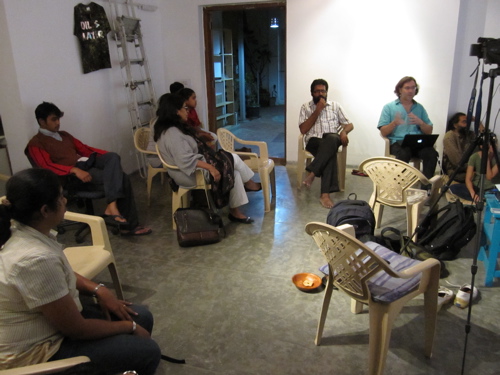
At the Centre for Internet and Society (CIS) Cunningham Road, Bangalore
Recently, n.e.w.s. won the ‘Competition of Ideas’ for authoring a book proposal entitled “Arbitrating Attention”, which would explore new economic and social contexts for art. This 100-page text will be published at the beginning of next year. One of things n.e.w.s. hopes to do in the book is tap the undercurrent of new economic experiments in the way artistic activities can be de-framed yet incorporate survival tactics for sustainability.
A response to Joselina:
Joselina cites an essay of mine, (“Biennale Demand”, Jan 2008, http://www.aaa.org.hk/newsletter_list.aspx?newslettertype=archive), where I contrast the notion of “convention” with that of “tradition”. She summarises me as saying that “biennales have conventions, but not tradition”. And then she goes on to say: “This may be true to an extent, but following his definition of tradition, biennales, either through the foundations or offices that run them, or through the curators chosen, are hardly oblivious to past biennales that occur around the world. The derivative models from Venice’s formula are a reaction to the original biennale’s framework. The exhibition concepts, thematics, ideas are never realized while the curator is unaware of what’s been done elsewhere. Curators and directors are hardly, never reflexive. Most are. And the biennales they come up with are products of these. Are these then not the creation of a tradition?”
Opening remarks by Susan, Michael, Carla, Thomas, Joselina and Weng Choy.
Models for (the) People, by Tiong Ang
Art from Asia is on the rise — or so it must seem. From Sydney to Shanghai, Busan to Berlin, Asian artists are all over the place. The year 2008 was a banner year for biennales in this part of the world. September alone saw several biennales and triennials opening, including Gwangju, Busan, Shanghai, Guangzhou, Singapore, Taipei and Yokohoma. However, research and analysis of contemporary art from the region have not kept pace with the spectacle of exhibition. And it’s arguable that this underdeveloped state of discourse is an urgent concern. What we need, perhaps, is less chatter, and more reflection. Hopefully, in this forum here, we’ll be able to serve up some of the latter along with some of the former.
The Asian Biennales Forum, Part II, is a follow-up from the forum which took place in November 2008. http://northeastwestsouth.net/site/node/256
February 16th-March 4th at n.e.w.s
Introverts are people who do not generally demonstrate an enthusiastic social appetite. Most Internet interfaces and applications assume a voluntary and natural tendency for social bonding and seem to reward behaviour that fits these assumptions. What is our understanding of people who would broadly identify themselves as introverts? Can this inquiry inform our design efforts and guide us in reconceptualizing ways of working?
This forum will try to understand the position of the introvert and their actions. How do the questions of access and representation in context of attention reconcile with our desire to sometimes be quiet? Being quiet, because silence is comfortable, there are things that need to be said, but only if we remember or because it is necessary to speak, write. Being as introverted as we choose to be. Without a need for attention.
If we are to understand the attention economy of the web as it exists and as it is being shaped, understanding the invisible -the shadow-players in the system- is crucial. How can we measure and value actions that might never have been done? Would the systems, design paradigms and business models we take for granted, change with a better understanding of the introverts? Is it possible to strike a balance between showing and hiding, between spectacle and subtlety, privacy and transparency?
Hello! I see that some slackers have been more than punctual in taking the initiative and getting this forum under way. Whereas some others, ahem, have waited for the sun to warm the earth before sallying forth. This is just as it should be, for it places us straightaway at the heart of the issues we are to address: the paradoxes of slackerdom.
Three questions are of supreme interest to me with respect to what I take to be our common concern in performing the everlasting Sunday:
- Why is authentic slacking different than mere laziness (if it is)? I choose that phrasing deliberately to underscore the ticklish distinction between the two: I feel it is somehow slacker-incompatible to identify an “authentic” as opposed to an inauthentic mode of slacking, just as it is absurd to suggest that describing laziness as “mere” does anything but upgrade it to some more interestingly corrosive status. Still, it strikes me as useful, even necessary to attempt to conceptualize slacking off as a specific way of being in the world – as opposed to indolence or idleness (and other agreeable states) on the one hand, and languor or what Christians call slothfulness on the other.
- This ontological speculation on slacking’s core definition begs the second question: slacking’s political ontology. By both slacking off from the imperative to work and, symmetrically, deliberately abstaining from leisure and other modes of consumerism, slackers embody a fascinating – and for the productivist majority, infuriating – performative double bind, akin to the famous “I am a liar” that had the Greeks stumped. Slackers don’t “just” slack off; they go at it full-tilt. Clearly, the studied and ostentatious practice of doing not much at all is all-consuming. But is it subversive? Does it have seditious potential within a regime of productivism? Can it obstruct the reifying logic of “creativity” and “artistic research projects” we hear so much about?
We are very delighted to announce that n.e.w.s. has won the 'Competition of Ideas', with our text Reinvesting attention surplus in plausible artworlds